Stabilizing digital operations to support rapid manufacturing scale while reducing downtime risk, release friction, and avoidable replacement costs.
Case Study

A Fortune 500 diversified life sciences company opened a $90 million facility built to manufacture viral vector gene therapies for its biotech customers.
Determined to make it a state-of-the-art facility, the company’s leaders saw an opportunity to reengineer its existing data management approach. The problem was that data silos separated instruments, equipment, and systems, affecting everything from production efficiency to quality to security. Point-to-point integrations between systems were cumbersome and complex. There was a lack
of data contextualization and too many inconsistent data formats, requiring additional validation efforts.
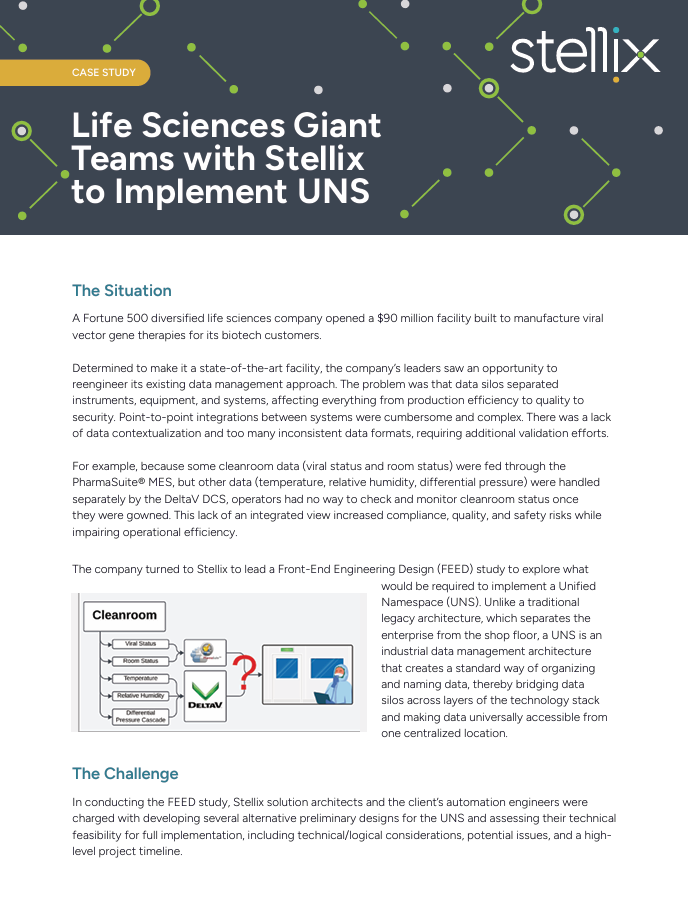
For example, because some cleanroom data (viral status and room status) were fed through the PharmaSuite® MES, but other data (temperature, relative humidity, differential pressure) were handled separately by the DeltaV DCS, operators had no way to check and monitor cleanroom status once they were gowned. This lack of an integrated view increased compliance, quality, and safety risks while impairing operational efficiency.

The company turned to Stellix to lead a Front-End Engineering Design (FEED) study to explore what would be required to implement a Unified Namespace (UNS). Unlike a traditional legacy architecture, which separates the enterprise from the shop floor, a UNS is an industrial data management architecture that creates a standard way of organizing and naming data, thereby bridging data silos across layers of the technology stack and making data universally accessible from one centralized location.
In conducting the FEED study, Stellix solution architects and the client’s automation engineers were charged with developing several alternative preliminary designs for the UNS and assessing their technical feasibility for full implementation, including technical/logical considerations, potential issues, and a high-level project timeline.
As part of the study, the client also sought Stellix’s help in selecting and designing an MQTT broker and Data Operations platform to receive, filter, and deliver Industrial Internet of Things (IIoT) messages using the MQTT protocol, as well as evaluating and selecting an IIOT-ready Human Machine Interface (HMI) to visualize and monitor data in real time.
As a preliminary use case for the FEED, the Stellix team needed to:
Within a matter of weeks, the Stellix team and its partners had designed and specified a UNS architecture for the company’s viral vector facility, harmonizing its legacy components and providing a springboard for greater scalability, agility, and innovation while reducing integration costs.
At the conclusion of the engagement, the Stellix team delivered a report summarizing considerations and prerequisites for full deployment, as well as estimated resourcing and a schedule for activities associated with full deployment.
The site automation team was pleased with Stellix’s work and provided an internal demo to site leadership and manufacturing management. The demo was well received, with manufacturing management seeing the value that the UNS provides for both near-term and future integrations.
Stellix and the client continue to work on developing the project for full deployment, including:

The next step is to align on a plant outage period to perform the physical installation tasks that impact cleanrooms.